The short answer
Often yes—and in some jurisdictions it is required. Before printing, check the current advertising rules of every state or local licensing authority that covers the work. If a number is required, reproduce the active number and any prescribed label exactly, keep it legible, and make sure the business name matches the licensing record. Do not print “licensed,” “bonded,” or “insured” unless each claim is accurate and current.
Check the rule before choosing the layout
There is no single nationwide business-card rule for every contractor. Requirements depend on the jurisdiction, trade, license type, and way the business advertises. Oregon, for example, expressly requires a CCB number on contractor business cards, while other authorities use different labels, formats, or advertising rules.
Start with the official licensing board or registration authority—not another contractor’s card. Confirm which business name must appear, whether the number needs a prefix, and whether the rule applies to each trade or location served.
- Use the exact active license or registration number
- Follow any required prefix or wording
- Match the printed business name to the official record
- Recheck the rule before every reprint
Place the number where it survives real-world use
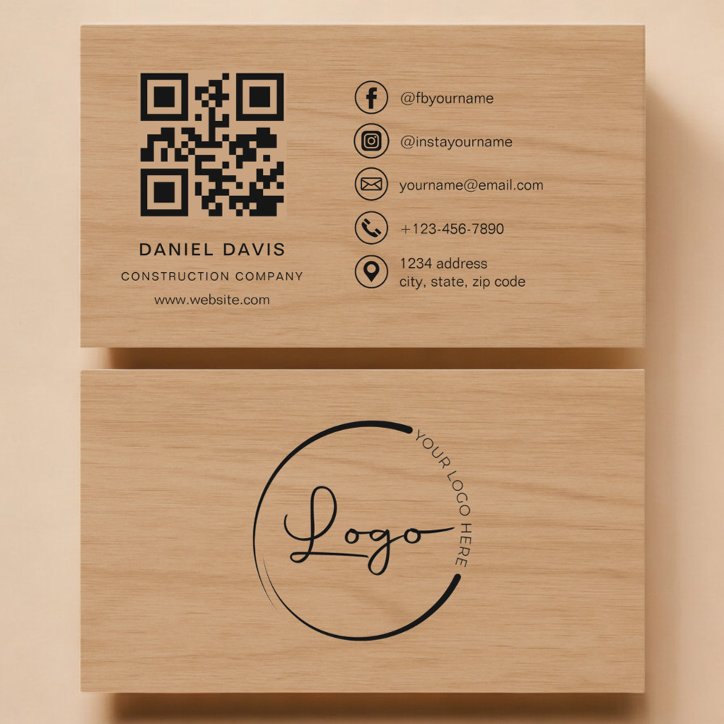
A required number should remain readable at actual card size and after trimming. It can sit in a quiet footer on the front or in a clearly labeled details block on the back, provided the applicable rule does not prescribe another placement. Do not hide it in a QR code, crop it into the bleed, or shrink it until it is only technically present.
Treat the number as verifiable information, not decoration
A customer may use the number to look up the contractor, so accuracy matters more than prominence. A short label such as the authority’s prescribed abbreviation can make the number understandable without turning it into the largest element on the card.
Keep separate claims separate. A license number does not by itself prove that every insurance policy, bond, certification, or endorsement is current. The Federal Trade Commission’s general advertising guidance also requires claims to be truthful, non-deceptive, and supported.
- Do not borrow another company’s number
- Do not imply a trade classification you do not hold
- Verify bonded and insured wording independently
- Use a current official lookup destination if the card includes a verification QR code
Proof the compliance details with the contact details
Check the license number character by character along with the phone number, website, business name, and QR destination. Compare the final proof with the official record and view both sides at actual size. If a license, registration, or business name changes, update the card before continuing to distribute old stock.